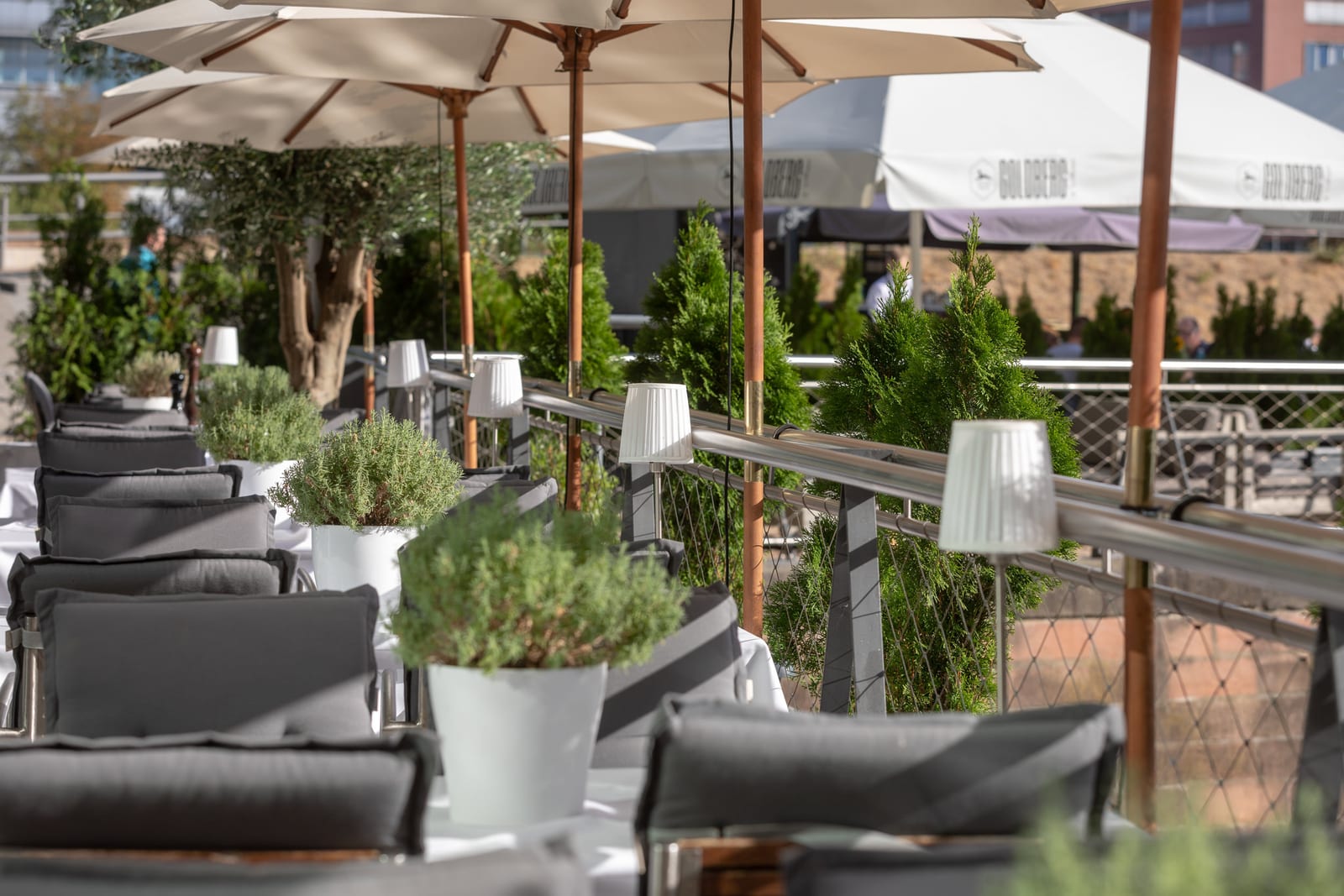
Water changes the way a place to eat is read. It opens the view, reflects light and often becomes an important part of the experience, even when it appears in the picture only as a narrow band in the background.
Two houses in the archive lie far apart and still share the same task: a harbor basin in the middle of the city, and a vineyard above the Rhine valley.
Two locations, two visual languages
The Frankfurter Botschaft connects its terrace directly to the harbor basin. Planting, railings and staggered seating areas lead the eye towards the river. In the Rheingau, Das Rebenhaus sits under a canopy of vines above the valley, with the river and the vineyards defining the surroundings.
The difference is not only scenic. In the city the water stands for proximity to the office and for an evening on the quay. In the vineyard it stands for distance, for the drive out and for a day trip that fills the whole day.
Why one interior frame is not enough
In productions like these a classic interior photograph does not do the job. The relationship between table, terrace, landscape and water has to stay visible. Overviews, lower viewpoints and aerial frames therefore sit alongside the food and detail pictures.
- An overview that brings the house and its location into one frame.
- The terrace from seated height, so a guest can follow the view.
- A laid table with the water recognizable behind it.
- Close frames of dishes and drinks in the available daylight.
- An aerial frame wherever the shoreline or the slope cannot be explained otherwise.
A series about location
The series connects very different hospitality concepts through where they stand: from the modern Westhafen to a cultivated wine landscape.
For the houses themselves that is the practical part. Someone looking for a table by the water often decides on the strength of a single picture, and that picture has to show both things at once. More work is under restaurant and hospitality photography.
Is your restaurant due for new photographs?
Scope and price are fixed before anything is photographed or filmed. The inquiry commits you to nothing.